We knew it would be hard. Everyone tells you that. What nobody tells you is that "hard" is a wildly insufficient word for what happens when your home becomes a building site and you are still expected to live, work, sleep, eat, and function like a normal human being inside it.
We were told the renovation would take three months. Three months. We could do three months, we thought. We are reasonable, patient people. Three months is a long holiday. Three months is a Netflix series.
It took nine.
Our canal house renovation lasted nine months. We lived in it for most of them, escaping for a handful of trips when we could no longer face the dust.
The Scale of It
I should be clear about what we are talking about here. This was not a new kitchen. It was not a bathroom refit or a bedroom refresh. This was a full gut renovation of the top two floors of an Amsterdam canal house (grachtenhuis). Every wall, every floor, every pipe, every wire.
It did not start that way. We thought it was going to be largely cosmetic: new paint, updated finishes, some careful modernisation. But once the walls came off, the reality behind them changed everything. Rotten timber, outdated wiring, plumbing that needed replacing entirely. What began as a cosmetic renovation became structural very quickly.
Living through a gut renovation is a fundamentally different experience to living in one section of your house while another section gets a new kitchen or bathroom. When it is room by room, you have somewhere to retreat to. You have a functioning kitchen, or a working bathroom, or at the very least a room that feels finished. You can close a door and pretend the chaos is not there.
When it is the entire house, there is no retreat. Every room is a building site. Every surface is covered. Every system, water, electricity, heating, is disrupted at some point. You are not living alongside a renovation. You are living inside one.
That distinction matters, because everything that follows in this piece only makes sense if you understand the scale. This was not inconvenient. It was all-consuming.
The Dust
Let us start with the thing that defines renovation life above all else: dust.
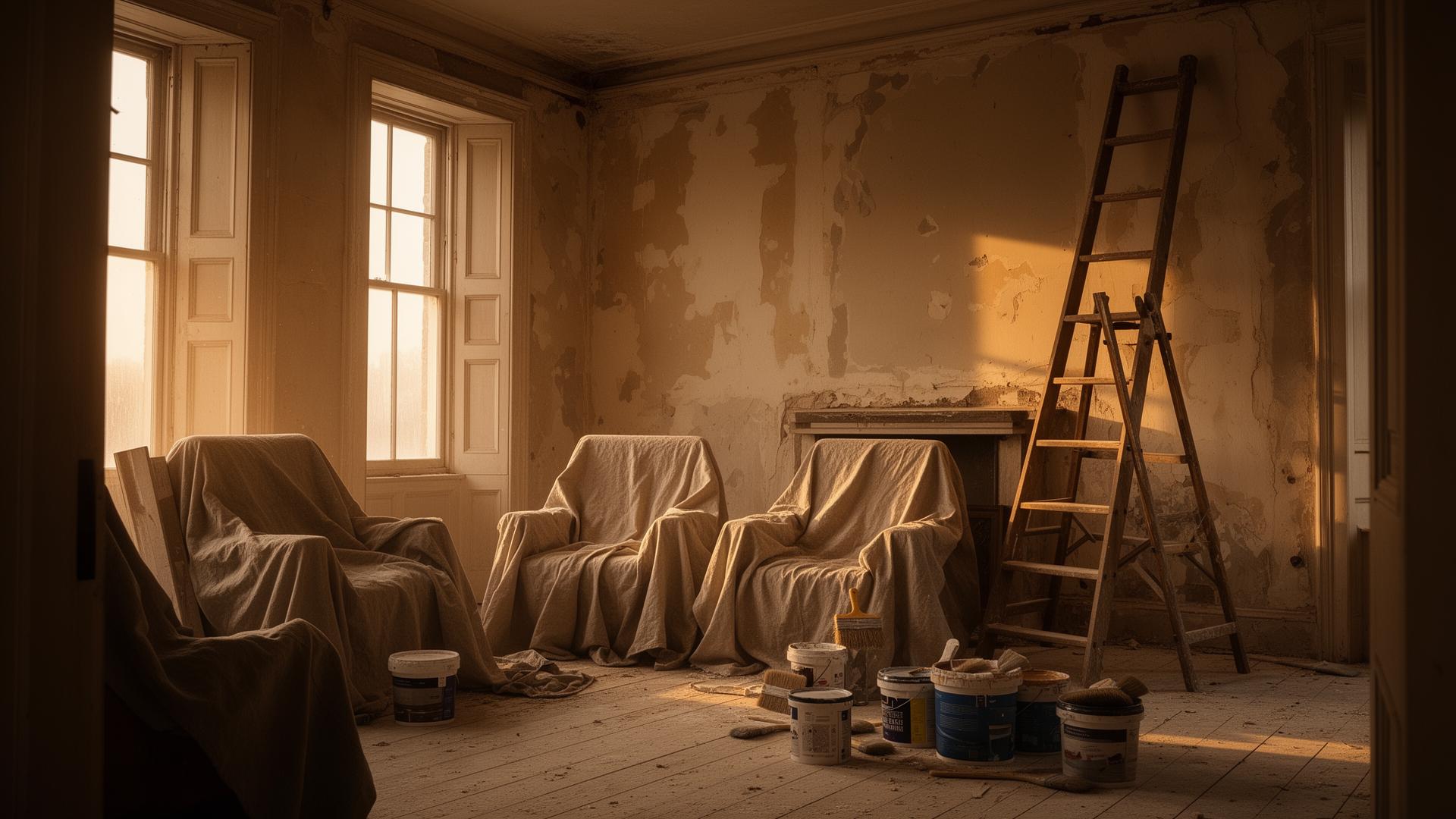
We had ceiling beams sanded back. Decades of paint, stripped down to bare wood. If you have ever wondered what centuries of paint looks like when it becomes airborne, the answer is: it looks like fog. A fine, relentless, beige fog that settles on every surface you own within minutes of cleaning it.
Your morning coffee has a film on it before you have taken a sip. Your laptop keyboard crunches. Your pillowcase feels gritty by lunchtime. You wipe a shelf and the cloth comes away brown. You wipe it again twenty minutes later: brown again. You stop wiping.
We taped plastic sheeting over doorways and stuffed towels under doors. We should have bought an industrial air purifier but somehow never did. If you are reading this before your renovation starts: buy one. Buy two. It will not solve the problem but it might preserve your sanity.
At some point, you stop fighting the dust and simply accept that you are living inside a very expensive snow globe.
And here is the thing nobody mentions: the dust does not end when the renovation ends. It took months afterwards to truly get rid of it. It hides inside light fittings, behind radiators, in the grooves of floorboards. You think you have finally conquered it, move a piece of furniture, and there it is again.
The Facilities Problem
Our house had six sinks. Six. This sounds extravagant until you understand the layout: our apartment is the top two floors of a canal house, and both bedrooms had their own sink, as older Amsterdam houses often do. We felt quietly prepared, thinking at least we would always have somewhere to wash up, brush our teeth, fill the kettle.
They took out four in the first fortnight. We were left with two: the one in the guest bedroom where we were sleeping, and the kitchen sink, which was technically still there but permanently in use for cleaning brushes and tools. So functionally, one sink.
Our one properly functional room was the WC: a toilet and a small basin. We went away for a few days and came back to find they had removed the basin. The timing made no sense at all. It was not even part of the phase they were supposed to be working on.
Working From Home (in a Building Site)
We both worked from home. Spencer runs a consultancy, so his days were full of client-facing calls. I was running our online wine shop, Raravina, at the time, not yet Epoch.
Imagine taking a client call while someone drills through a wall in the next room. Imagine the particular joy of a video meeting where your background is a sheet of plastic taped over what used to be a doorway, and three men are discussing, at considerable volume, whether a pipe should go left or right.
Mute became our most-used button. "Sorry, there is a bit of work going on" became our most-used sentence.
Sunday was the only day without trade. The only day we did not wake to the sound of boots on the stairs and radio music we did not choose. Six days a week, the house belonged to the builders. On Sundays, for a few quiet hours, it almost felt like ours again.
The Noise
Nobody prepares you for the noise. You know there will be noise, obviously. It is a building site. But knowing and living inside it are entirely different things.
For me, the sanding was the worst. The high-pitched, grinding whine of sanders on beams and floors, hour after hour. It gets into your head in a way that drilling somehow does not. Drilling is aggressive but intermittent. Sanding is constant, monotonous, and inescapable. It fills every room, vibrates through the walls, and follows you even when you close a door.
There are days when the noise starts at eight in the morning and does not stop until five. You cannot concentrate. You cannot have a phone conversation. You cannot think. And because you are living in it, there is no escape. You cannot leave and come back when it is finished, because it is never finished. Tomorrow there will be more.
The Logistics of Amsterdam
Renovating a canal house comes with a particular set of logistical challenges that you do not fully appreciate until you are living through them.
Our apartment is the top two floors. Everything, every tile, every beam, every sheet of plasterboard, came in either through the canal doors or up the stairs. Narrow staircases, steep angles, no lift, no easy route. Materials arrive and have to be carried up by hand or hoisted on ropes.
The kitchen worktops came through the canal doors. The kitchen island slabs of quartzite were terrifying. Watching those being manoeuvred through the canal doors and up into position was one of those moments where you hold your breath and try not to think about the replacement cost.
Building waste would generally be cleared through the canal doors on ropes and pulleys, once a week. In between, it sat inside the apartment taking up valuable space, alongside new materials waiting to go in.
We did not have a skip on site. We had many, but they were off-site, which meant everything that came out of the house had to be lowered down and driven away. Deliveries block the street. It is a choreography of timing and patience that would test anyone.
And then there was the cabinet. At the very beginning of the renovation, I found the most amazing colonial cabinet measuring 200 x 100cm. I had to have it. The timing was not ideal, to put it mildly, and the trade ended up working around it for the entire project. At one point it was hoisted up into the beams so the floor could be worked on beneath it. Not a decision anyone would recommend, but it survived, and it is one of my favourite pieces in the house.
Eating, Sleeping & Bathing
Spencer and I love eating out. We love visiting Amsterdam restaurants, trying new places, making an evening of it. The first few weeks felt like a holiday. How lovely, we thought. Dinner at our favourite restaurant on a Wednesday. Breakfast at the corner cafe. This is almost glamorous.
But when eating out is your only option, and all you really want is your husband's home-cooked food, it gets tiring very fast. And expensive.
The cost is relentless. Every meal out, every coffee, every takeaway adds up to a shadow budget that nobody warns you about. On top of a renovation that is already costing more than you planned (because it always does), you are spending a small fortune simply feeding yourselves.
We already owned an air fryer. It became the centre of our existence. The kitchen technically still functioned in the beginning. We had worktops, an oven, the basics. But it was also the centre of the building work, which meant everything was covered in dust. Cooking in a kitchen where you have to wipe down every surface before and after use, where the oven door has a fine grit on the handle, where you are never entirely sure if that is flour or plaster dust: it wears you down quickly.
The air fryer moved to the guest bedroom. Spencer, who is a genuinely good cook, was reduced to air-fryer chips and whatever could be assembled in a bedroom with an air fryer and a sense of humour.
We had sold most of our furniture before the work started, and everything else went into our basement storage unit and Spencer's office. We were living in our guest bedroom with minimal clothing, minimal belongings, and no sofa. Just a bed. The bed was where we slept, ate, and worked. It was everything.
You are not sleeping well. Your bedding never feels truly clean. Your clothes feel gritty. You miss your sofa. You miss normality. You miss the simple pleasure of sitting down to a proper meal at a table in a clean room.
And then there is bathing. We had no shower facilities for months. We were lucky enough to have the most wonderful neighbours, who gave us keys to their apartments so we could shower and do laundry. There is something uniquely humbling about carrying your towel and shampoo to someone else's front door just to get clean. You are grateful, endlessly grateful, but you feel it. The loss of something so basic, so private, that you never once thought about before it was gone.
And laundry, which nobody talks about during a renovation, but should. We carried bags of clothes and bedding between apartments, up and down canal house stairs, weekly, for months. Keeping anything clean was an exercise in futility. You wash everything, bring it home, hang it up, and by morning it has a fine layer of dust on it. Clean sheets, dusty by dawn regardless.
The Strain
This is the part people do not talk about enough.
Spencer and I were not married yet when we started the renovation. Living through nine months of dust, noise, no facilities, and air-fryer dinners in a single room is, without question, the best test of any relationship. Better than any holiday, any house move, any argument about whose turn it is to cook. If you can survive a renovation together, you can survive most things.
And then there is the decision fatigue. The endless, relentless decisions. Every tile, every handle, every paint colour, every light fitting, every socket position. You think you have finished deciding and then someone asks you whether the grout should be grey or charcoal and you genuinely do not care any more. But you have to care, because it is your house and these choices are permanent.
On top of that, the weekly invoices. Labour costs, materials, things you did not know you needed until someone explained why you did. Every Friday, another email with a number attached. It never stops, and you never quite get used to it.
There is also the physical toll that nobody warns you about. I fell down the stairs one evening, my Boston clogs catching on the paper floor covering. Spencer was out at dinner. Our contractor picked me up. I was cut, bruised, and had a sprained wrist and shoulder. It could have been far worse. You are living in a building site, and sometimes it reminds you of that in the most literal way.
A renovation like this will test even the strongest relationships. It is not the big things that get you, it is the accumulation of small discomforts, the tiredness, the decisions, the lack of anywhere to just sit and be normal together. We are still here. We got married. But there were moments.
The Contractor Saga
This is the part I debated whether to include. But honesty is the point of this piece, so here it is.
We started with one contractor. The price was agreed. A payment plan was set up. Everything felt professional and structured. And then, despite the agreement, despite the plan, despite the money we had already paid on schedule, they could not continue without further funds. The three-month timeline stretched and stretched, and eventually the relationship broke down entirely.
We had to find a new team to finish the job. Luckily, and I mean luckily, we found an amazing team who came in, assessed the situation, and got on with it. They were the reason the house got finished at all.
But here is where it gets truly stressful.
We had a sub-contractor for our built-in furniture, arranged through our original contractor. We had paid our contractor for that work. They had not passed the money on. All our communication with the furniture maker had gone through the contractor, so when the relationship ended, we had no direct contact details. Our contractor refused to share them.
We found them through Google Image search. Genuinely. We recognised a piece of their work in an image online, traced it back, and made contact. It turned out the furniture was made and ready to be installed. They had done beautiful work and received nothing for it. We came to an agreement directly, and they installed everything. They were wonderful about a situation that was not remotely of their making.
It is one of those renovation stories that sounds dramatic in the retelling but at the time just felt exhausting and unfair. The lesson, if there is one: know your sub-contractors. Get their details. Maintain a direct line of communication, even if your main contractor prefers otherwise.
How Long Things Actually Take
Before you undertake a renovation, you genuinely have no idea how long anything takes. You imagine tiling a bathroom is a day or two. It is a week, sometimes more. You think plastering a room is an afternoon. It is days, and then it needs to dry, and then it needs sanding, and then a second coat, and then more drying. Every single job has phases you did not know existed.
You learn this slowly, and it recalibrates your entire understanding of the project timeline. What you thought was a three-month renovation becomes nine months not because anyone is being slow, but because the work simply takes as long as it takes. Each trade has its own pace, its own process, and its own dependencies on the trade before it.
Even with a strong brief, even with detailed plans and a clear vision, things change. Walls come down and reveal problems that were not visible before. A floor that was supposed to be sanded needs replacing entirely. Every discovery costs time and money. Every change requires a conversation, a decision, sometimes a mourning period for the plan you had. You learn to hold your vision loosely and your budget even more loosely.
We went away a few times, partly to escape, partly because the work was supposed to reach a milestone while we were gone. We came back to find almost no visible progress. You know intellectually that progress is happening behind the walls, in the wiring, in the plumbing. But emotionally, walking into a house that looks exactly as chaotic as when you left is hard to take. If you go in understanding that reality, you will still be frustrated, but at least you will not be surprised.
The Money
Ah, the money.
There is the renovation budget, which is the number you agreed on and feels eye-watering at the time: the labour, the materials, the fixtures and fittings, the hardware. Then there is the furniture, which somehow never makes it into the original number despite being the thing that actually makes a house liveable.
Then there is the actual cost, which is all of the above plus the things nobody told you about: the temporary living costs, the eating out, the storage tubs you rented to keep your belongings safe (we did not pay for a storage unit, but we rented plastic tubs, and then ended up buying them outright when the renovation dragged on far longer than planned). And then, if you are particularly unlucky, there is the cost of a second contractor finishing what the first one started, and paying a sub-contractor directly for work you have technically already paid for once.
The honest advice: build a generous contingency into your plans from day one. Future you will be grateful.
Tips for Surviving It
If you are about to live through a renovation, or you are in the thick of one right now, here is what I wish someone had told us:
Befriend your neighbours. Seriously. Ours gave us keys to their apartments so we could shower and do laundry. Without their kindness, I do not know how we would have coped. Return the favour tenfold.
Protect your essentials. Your coffee machine, your kettle, your air fryer. These small comforts become disproportionately important when everything else is chaos. Guard them. Keep them clean. Better still, set up a separate tea and coffee station for your trades team so yours stays out of the firing line.
Seal your clothes. Put anything you care about in vacuum bags or sealed containers. The dust gets into wardrobes, drawers, folded stacks. You will put on a jumper and wonder why it smells like plaster.
Get every sub-contractor's details on day one. Names, phone numbers, emails. Do not rely on your main contractor to be the gatekeeper. If the relationship breaks down, you need to be able to reach the people doing the actual work.
Stay on top of your leadtimes. Materials, tiles, fixtures, hardware: everything has a leadtime, and it is almost always longer than you expect. Tiles from Italy take eight weeks. A specific tap gets discontinued. The worktop you chose is out of stock until next quarter. Order early, chase often, and keep a running schedule of what needs to arrive when. Leadtimes that slip become delays that cost you weeks.
Watch the floor coverings. Paper sheeting on stairs is slippery, especially in certain shoes. I learned this the hard way. Make sure coverings are taped down properly and think twice about your footwear on site. A building site has genuine hazards, and you are walking through them every day.
Accept that by the end, you will just want them to leave. However lovely your trades team are, and ours were genuinely wonderful, there comes a point where you no longer care about perfection. You do not need the absolutely perfect house. You just need your home back. You need the boots off the stairs and the radio off and the front door to be yours again. It passes, and you will appreciate the quality of their work once you have had a week of silence. But that feeling of desperately needing your own space back is completely normal, and nobody warns you about it.
Consider hiring an interior designer, especially one who has lived through it. The decisions alone can be overwhelming: the finishes, the fixtures, the layout changes, the things you did not know you needed to decide. Having someone who understands the process, who has felt the decision fatigue and the chaos and the dust, makes a genuine difference. They can manage the details you are too exhausted to think about and keep the vision on track when you have lost sight of it.
The Light at the End
There is a point, and it feels impossibly far away for most of the project, where the house starts to come back together. The trades begin to leave, one by one. The dust settles for real. Rooms start to look like rooms again.
The best part is the decorating and dressing. Choosing where art goes. Laying out furniture. Styling shelves. This is the moment you have been waiting for, the reason you did all of it. But it comes at the very end, after months of mess and noise and chaos, and you have to earn it.
My one piece of advice for when you reach this stage: do not rush it. Do not put on your beautiful new bedding while there is still sanding happening in the next room. Do not hang curtains while painters are still finishing skirting boards. Wait. Let the final dust settle. Let the last boot leave. And then, only then, dress the house. It will feel like the most satisfying thing you have ever done.
It feels, for months, like the work will never end. But your house is put back together bit by bit, and one day you wake up and it is yours again.
Was It Worth It?
Would I live in a large-scale renovation again? No. Absolutely not. But was the renovation itself worth it? Without question. I love our house. I love every room, every detail, every surface that caused us stress and dust and decision fatigue. And the strangest thing is how quickly you forget. The noise, the chaos, the months without a shower: it all fades. What stays is the home.
But did I learn an enormous amount? Yes. More than I could have learned any other way. It is the reason I started Epoch. Every piece of advice I give my clients, every logistical plan, every conversation about what to expect, comes from having lived through it myself. Not theoretically. Not from a textbook. From nine months of dust, air-fryer chips, and cold-water sink washes.
It is worth being honest about what "worth it" actually costs. Not just in euros, but in patience, in comfort, in the strain on your relationship, in the mornings you wake up to drilling, in the months you cannot shower in your own home. In the stress of a contractor relationship falling apart and the relief of finding people who care about the work as much as you do.
Living through a renovation is survivable. Millions of people do it. But it requires a solid relationship, a sense of humour, a tolerance for chaos, and genuinely wonderful neighbours.
You will get through it. We did. And the dust does eventually settle.