You have found the house. You have survived the mortgage process. You have navigated the survey, the solicitor, and the surveyor's alarming observations about the roof. And now, finally, you get to make it yours.
Except 'yours' is plural. And the person you share your life with wants a completely different kitchen.
This is one of the most common conversations I have with clients. Two people, deeply compatible in every other respect, who discover at the paint-chart stage that they have fundamentally different ideas about what a home should look and feel like. One wants warm and layered. The other wants clean and contemporary. One wants colour. The other wants calm.
It is a more emotional conversation than people expect, because how we want our home to feel is deeply personal. It is not really about whether the sofa should be grey or green. It is about identity, comfort, and what makes you feel at ease in your own space.
Start with Feelings, Not Pinterest
The single most useful thing you can do before any design decision is to sit down together and talk about how you want your home to feel, without looking at a single image.
Not what style. Not what colours. How it should feel.
Safe. Light. Warm. Calm. Energising. Sophisticated. Relaxed. Welcoming.
You will almost certainly find more common ground here than you expect. Most couples want broadly the same feeling, they just picture different routes to it. One person's 'warm and inviting' is a wood-panelled study. The other's is a sunlit kitchen with open shelving. Both are valid. Both can coexist.
Finding Common Ground
Once you have established the feeling, look for the overlaps in taste rather than the differences.
Create a shared reference point. Visit a hotel, restaurant, or shop together that you both love. What is it about the space that works? This is often more revealing than any mood board.
Identify your non-negotiables. Each person gets two or three things they feel strongly about. Everything else is open for discussion. This prevents every decision becoming a negotiation.
Agree on a palette. Colour is where most disagreements live. Find a neutral foundation you both respond to, warm white, soft grey, natural linen, and build from there. Colour can then be introduced in ways that feel personal without overwhelming.
Practical Strategies That Work
Divide territory. Some rooms naturally lean toward one person's taste. A study or home office can reflect individual preferences without affecting the shared spaces. Bathrooms offer surprising freedom, they are contained, functional, and can be quite different from the rest of the house without feeling jarring.
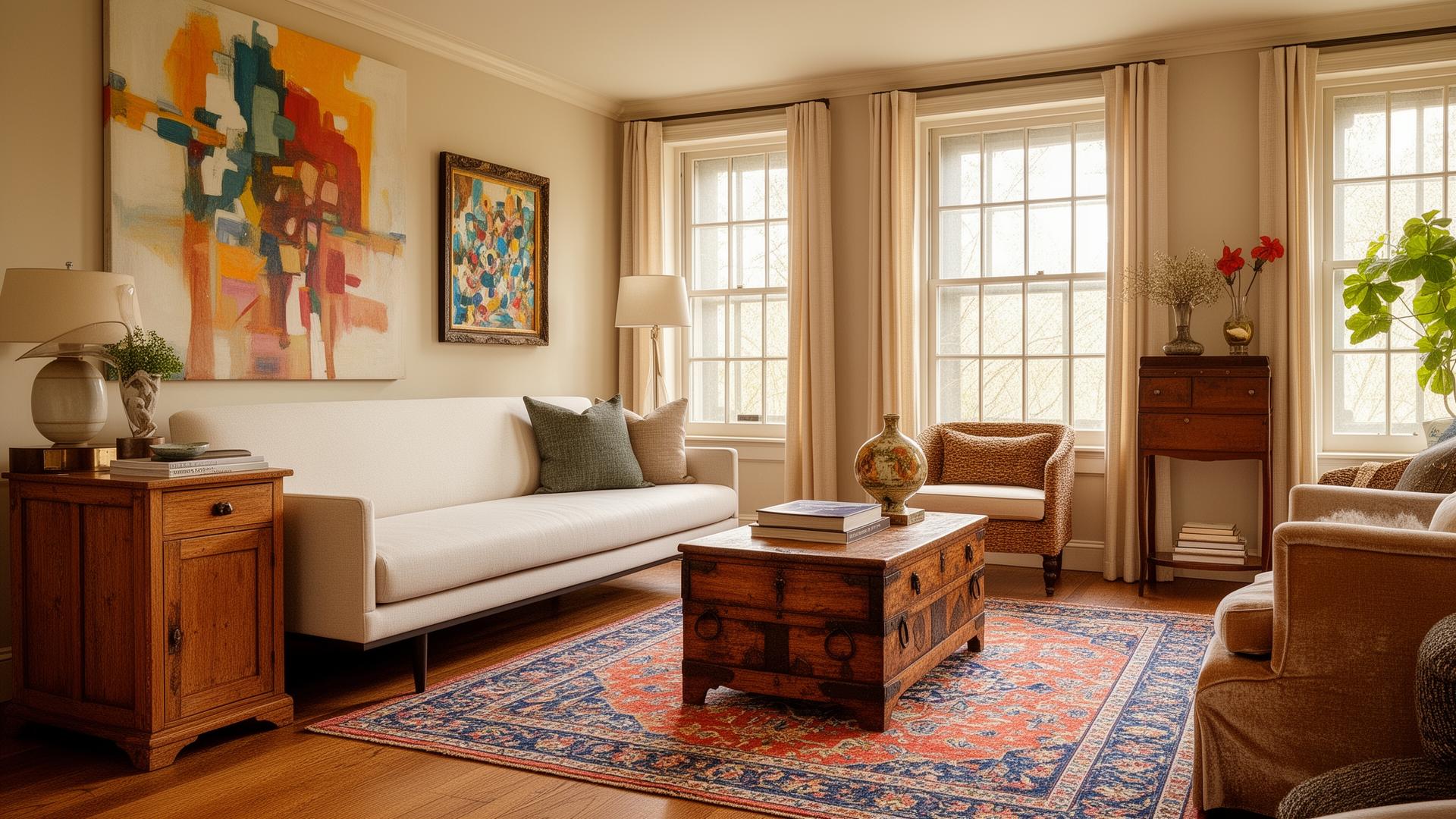
Use furniture as the bridge. A well-chosen piece of vintage furniture, something with warmth, texture, and character, often satisfies both minimalist and maximalist instincts. The person who wants clean lines appreciates the quality. The person who wants personality appreciates the story.
This is where sourcing carefully really matters. A beautiful oak table from a salvage yard, a pair of mid-century armchairs, a vintage brass lamp, these are the pieces that both people tend to love because they have integrity.
Layer, do not clash. If one person loves pattern and the other loves plain, use pattern sparingly and with intention. A single patterned cushion on a plain sofa. A wallpapered nook in an otherwise neutral room. A tiled splashback in a simple kitchen. The effect is considered rather than chaotic.
Invest in shared spaces, personalise private ones. The kitchen, living room, and entrance should feel cohesive, a shared aesthetic language. Bedside tables, bookshelves, and personal corners can be as individual as you like.
The Role of an Outside Eye
I say this carefully, because I am obviously not impartial. But one of the most useful things a design professional can do is mediate.
Not in a dramatic sense. But when two people are entrenched in opposing positions, a third perspective, someone who can see what both are reaching for and find the connecting thread, can unlock a conversation that has stalled.
I have lost count of the number of times a couple has arrived convinced they want completely different things, only to discover that the gap between their visions is much smaller than they thought. It usually comes down to a few key choices, a wall colour, a kitchen material, the style of a sofa, that, once resolved, allow everything else to fall into place.
What Not to Do
Do not compromise on everything. A home where every decision is a compromise ends up feeling like nobody's home. Better to have some spaces that feel strongly like one person's taste and others that feel strongly like the other's, with shared spaces finding genuine common ground.
Do not default to beige. The temptation, when you cannot agree, is to strip everything back to the blandest common denominator. This is the design equivalent of choosing a restaurant neither of you is excited about. Go somewhere one of you loves and the other is willing to try.
Do not let Pinterest decide. Social media is useful for sparking ideas but terrible for making decisions. A beautiful image of someone else's home tells you nothing about whether that style would work in your space, with your light, for your life.
The homes I find most interesting are the ones where you can sense two people. Where the mid-century sideboard sits next to the inherited armchair. Where the art is varied because it was chosen by different eyes. Where the kitchen reflects one person's love of cooking and the living room reflects the other's love of reading.
A home that reflects two people is not a design problem to be solved. It is an opportunity. The tension between different tastes, when handled with generosity and good humour, creates rooms that are more layered, more personal, and more alive than anything a single vision could produce.
The goal is not to agree on everything. It is to create a home that feels like both of you.