French flea markets remain one of the richest sourcing grounds in Europe. For anyone furnishing a home with character, or planning a first buying trip, the question is rarely whether to go but where to begin, what to look for, and how to bring pieces home without regret.
This is a guide to the landscape, drawn from years of working with French dealers, shippers and clients planning their own trips.
Why France, and Why Still
France retains a depth of supply that is hard to find elsewhere in Europe. The country industrialised earlier than most, the bourgeois household held onto its furniture for generations, and the tradition of the brocante is woven into the rhythm of provincial life. Even now, with much of the market online and dealers more sophisticated than they once were, honest pieces are still available at fair prices for those who know where to look and what they are looking at.
It is worth being clear-eyed about the experience. Sourcing trips are tiring, often cold or hot in the wrong measure, and a great deal of mediocre stock has to be sifted before a piece worth carrying home appears. The rewards are real, but they cannot be replicated by scrolling a website.
The Big Three in and around Paris
If a weekend is all the time available, Paris is the place to spend it. Three markets are widely regarded as essential, and they serve very different purposes.
Marché aux Puces de Saint-Ouen
The largest antiques market in the world, sitting on the northern edge of Paris in the suburb of Saint-Ouen. It is open Saturday, Sunday and Monday, and it is not a single market but a constellation of around a dozen, each with its own character.
For interiors, three are most often recommended. Marché Paul Bert Serpette is the most polished, with dealers showing eighteenth and nineteenth century furniture, twentieth century design, and carefully restored decorative pieces priced accordingly. Marché Dauphine is gentler on the wallet and stronger on lighting, mirrors and smaller decorative objects. Marché Vernaison is the oldest and most labyrinthine, rewarding the patient with textiles, ceramics, ironwork and curiosities.
A few practical notes. Most dealers at Saint-Ouen are professional and prices reflect that. There is room to negotiate, but not to halve the asking price. Cash is preferred for smaller purchases. Many of the better dealers can arrange shipping or hold a piece while logistics are sorted, which is covered in next week's guide.
Marché aux Puces de Vanves
Vanves sits at the southern edge of the city and runs only on Saturday and Sunday mornings, packing up by early afternoon. It is smaller, more domestic in scale, and the prices are kinder. The market has a reputation for ceramics, brass, smaller framed prints and the quiet decorative pieces that fill in the edges of a room. Arrive early. Most of the good things are gone by ten.
Marché aux Puces de Montreuil
Montreuil is the most local of the three, the least curated, and the most variable. It is worth a morning for anyone who has already done Saint-Ouen and Vanves and wants to see how Parisians themselves shop. Expect more clothing and bric-a-brac than fine antiques, but real finds surface among the noise for those willing to dig.
Beyond Paris: Brocantes and Vide-Greniers
The word brocante refers to a permanent or recurring market of secondhand and antique goods, usually run by professional dealers. A vide-grenier, literally "empty the attic", is the French equivalent of a car boot sale, run by ordinary households once or twice a year in their village or neighbourhood.
The brocante is where to go for stock that has already been selected by someone with an eye. The vide-grenier is where to develop that eye yourself, sifting through the contents of someone's grandmother's house and paying very little for the things you spot.
A few worth planning a trip around:
- L'Isle-sur-la-Sorgue, Provence. The largest and most celebrated brocante outside Paris, with a permanent village of dealers and two enormous fairs at Easter and in mid-August. Set aside two full days.
- Lille Braderie, Hauts-de-France. On the first weekend of September, the entire city becomes a flea market. Enormous, exhausting and exhilarating.
- Chatou Foire Nationale, Yvelines. Twice a year, in March and September, just outside Paris. Strong on furniture and lighting.
- Avignon and Arles, Provence. Smaller weekly brocantes that are excellent for textiles, ceramics and ironwork.
For vide-greniers, the calendar is published locally each spring on sites such as brocabrac.fr. Pick a region you are visiting anyway, and build a Saturday around two or three nearby villages.
Sourcing from Afar: Online Marketplaces and Auctions
Not every trip can happen in person, and the French secondhand market has moved online as quickly as everywhere else. These platforms are not a replacement for walking a market with your own hands, but they are a genuine extension of it, and for some pieces the only practical route.
Curated Marketplaces
Selency is the most established French platform for vintage and secondhand furniture, with thousands of dealers listing mid-century, Art Deco and twentieth-century pieces. Every seller is vetted, shipping is handled through the platform, and the search filters are good enough to narrow by era, material and region. I have sourced chairs, lighting and smaller case goods through Selency that arrived exactly as described. The pricing is fair rather than cheap; this is dealer stock, not attic clearance.
De Bon Goût (debongout-paris.com) is a Paris-based online boutique with a more decorative, antique-leaning edit. The selection is smaller and more curated, pitched at interior designers and serious collectors. It is useful as a window into what the trade is currently moving, and for harder-to-source decorative objects that rarely make it onto the larger platforms.
Auctions
Hôtel Drouot (drouot.com) is the principal auction house in France, with live and online bidding across dozens of sales each week. The estimates are usually realistic, the cataloguing is thorough, and the buyer's premium sits at around twenty-five to thirty per cent, so factor that into any ceiling price. Drouot is where pieces from closed châteaux and dissolved estates surface, and the occasional extraordinary lot appears at a modest estimate because the right bidders were not in the room.
Interencheres and Auction.fr aggregate sales from regional auction houses across France. The quality is more variable than Drouot, but so are the prices. I have found provincial furniture, garden pieces and quiet decorative lots at estimates well below what the same piece would attract in Paris. The trade-off is condition: condition reports are available on request, but I would only buy here when I can afford to be disappointed.
Proantic is a marketplace for professional antique dealers rather than an auction house. Prices are higher, but every piece is vetted and documented, and many of the dealers are the same ones you would meet at Saint-Ouen or Chatou. It is a useful source when you need something specific and do not have time to wait for the right market weekend.
A Word of Caution
I still prefer to see a piece in person where possible. Photographs flatter. Scale is hard to judge. And the subtle damage that matters, a hairline crack in ceramic, a warped drawer runner, a replaced hinge, is rarely visible in even the most honest listing.
Shipping a single chair from a regional auction or an independent dealer rarely makes financial sense unless you can consolidate it with other purchases. For one or two small pieces, the cost of transport, insurance and customs paperwork can double the landed price. Plan a shipment, not an impulse buy.
What to Look For, and What to Pass On
I always source with a brief in mind, never the other way around. Walking into a market without a list is how you come home with a beautiful object that has nowhere to live.
Categories that tend to reward the trip:
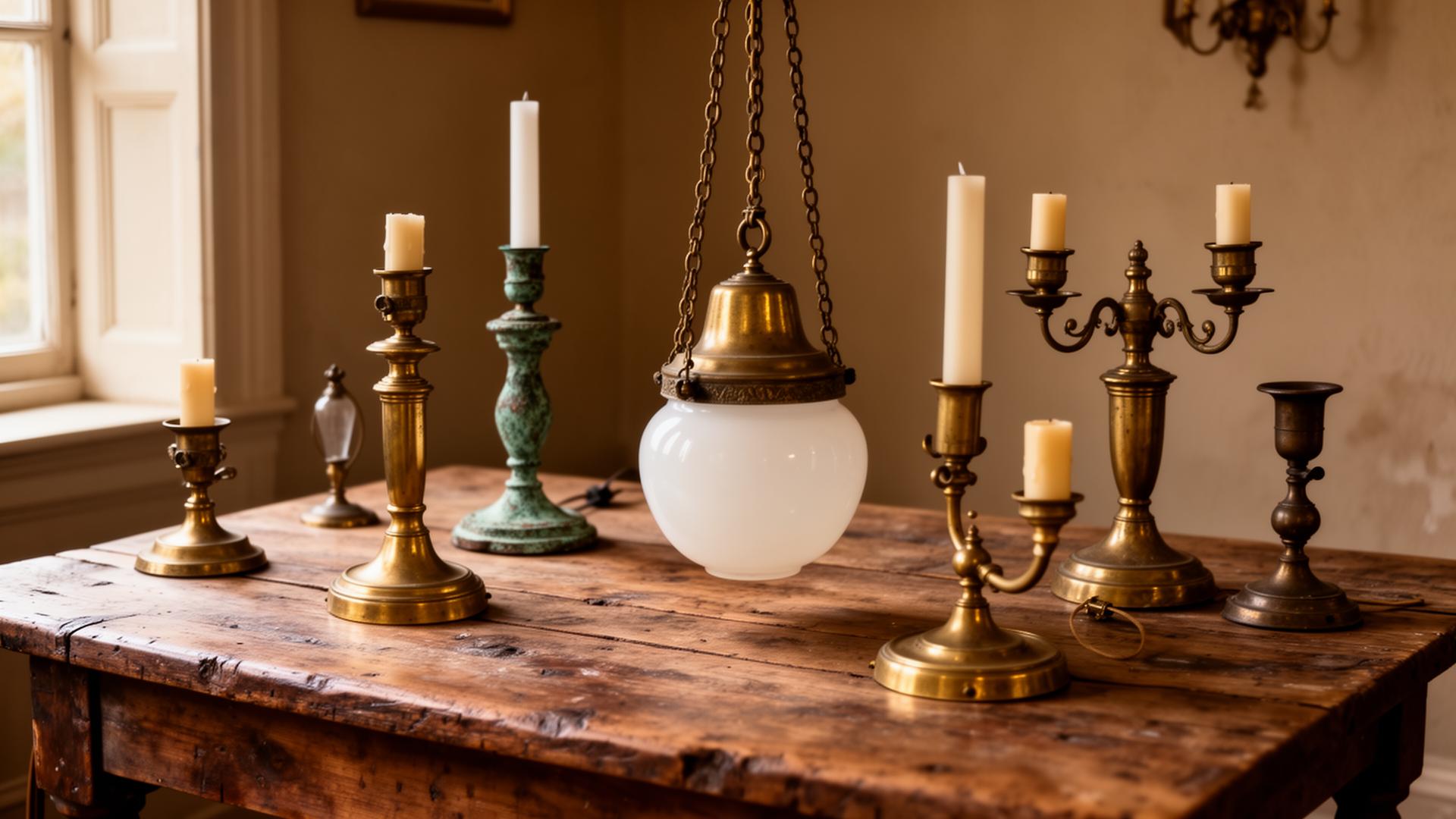
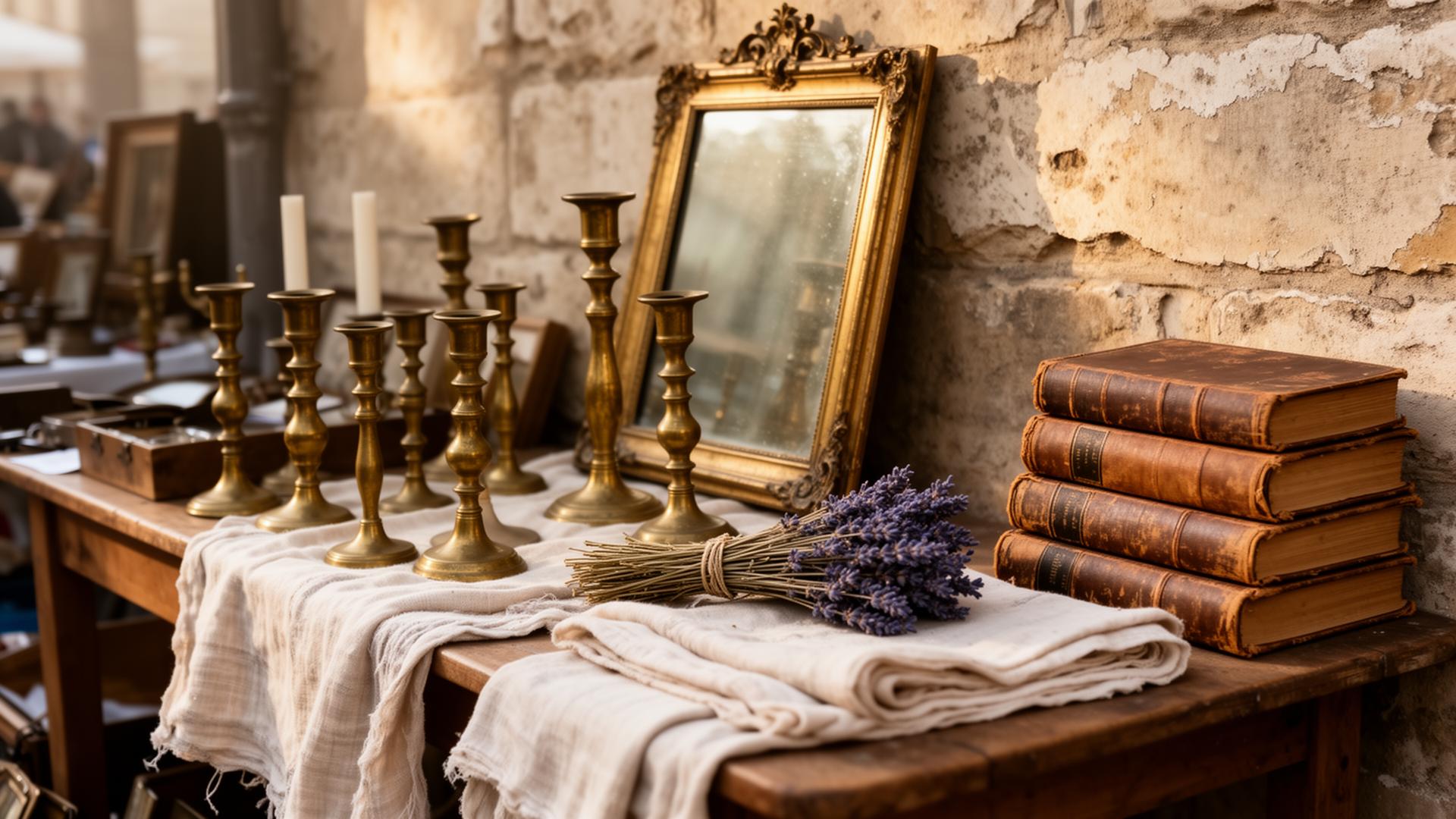
- Brass and bronze lighting. Table lamps, sconces and pendants from the 1920s through the 1960s. Living brass develops a patina no new piece can replicate. Always check the wiring; assume it will need to be replaced for European safety standards.
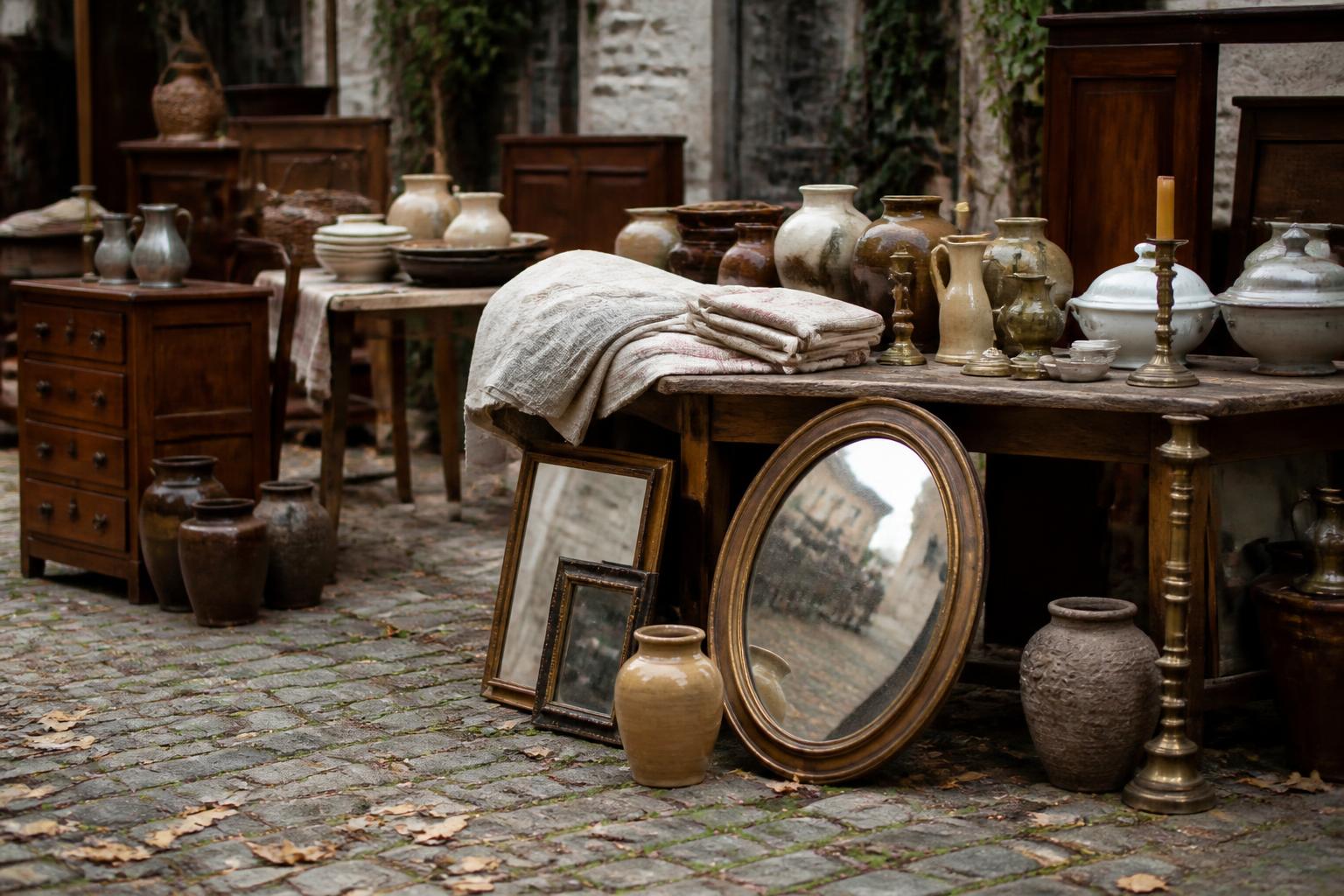
- Ceramics and stoneware. Provincial pottery, confit pots, tian dishes, hand-thrown vases. These are the pieces that make a kitchen or a console feel inhabited rather than styled.
- Mirrors. French gilded mirrors, particularly Louis Philippe, are widely available and often very fairly priced. Original mercury glass, when you can find it, offers a depth of reflection unlike anything modern.
- Linen and hemp textiles. Antique sheets, grain sacks and torchons can be made up into curtains, cushions and upholstery. Check for staining and weak seams.
- Smaller furniture. Stools, side tables, occasional chairs. These travel easily and slot into almost any room.
Categories that are usually better left behind:
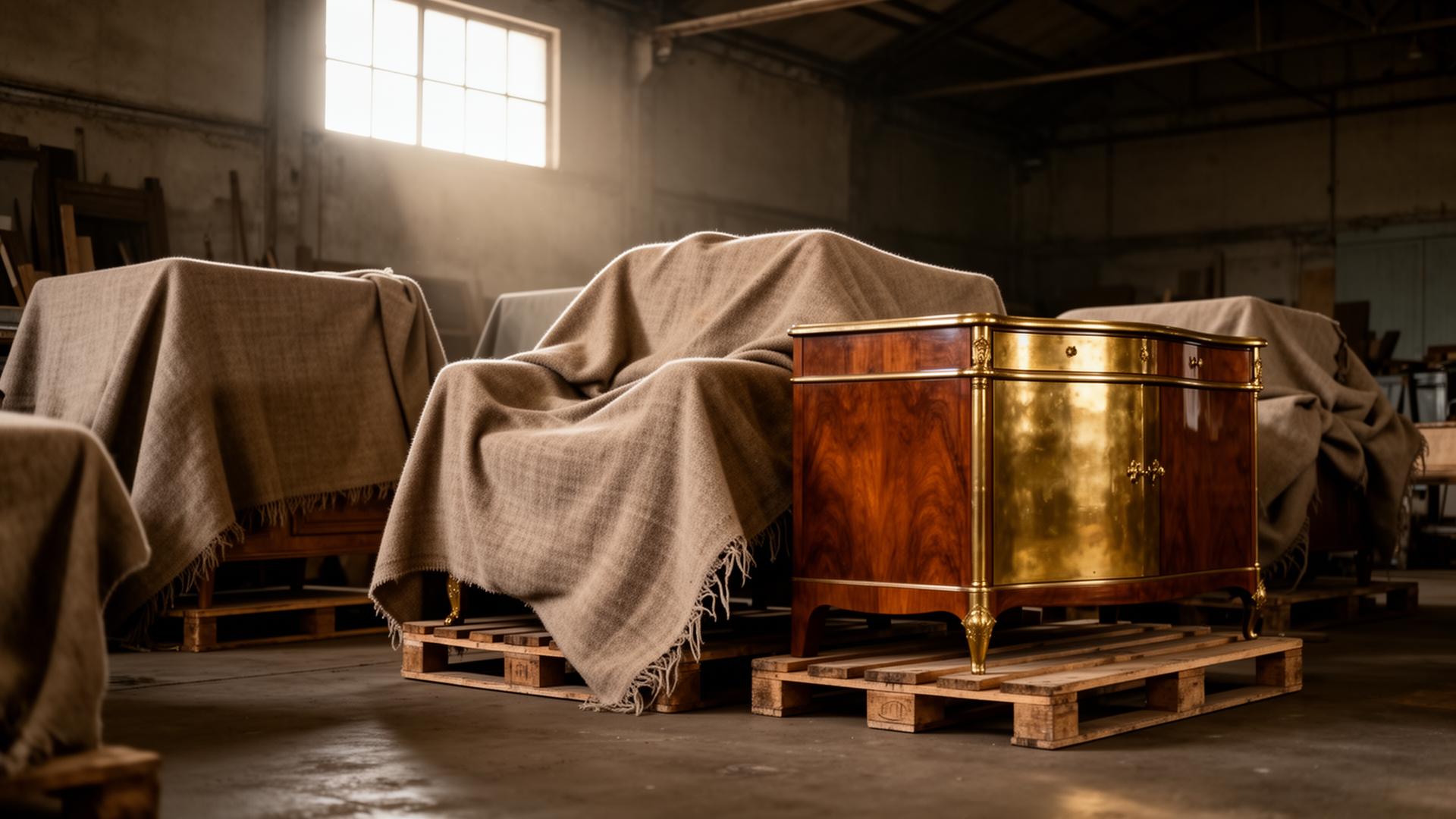
- Large case furniture unless its destination is known and the route in has been measured. Armoires are heavy, expensive to ship, and rarely fit a contemporary plan.
- Anything obviously restored to within an inch of its life. A piece that has been heavily sanded and revarnished has lost the patina that made it worth buying.
- Reproductions dressed up as antiques. The French market is largely honest, but not entirely. If a "nineteenth century" piece is suspiciously light, suspiciously perfect, or suspiciously cheap, walk on.
How to Negotiate Without Causing Offence
A few rules that hold across the country.
Greet the dealer properly. A simple "bonjour" before any other word is non-negotiable in France, and the difference it makes to the reception is significant. Switching to English afterwards is fine; skipping the greeting is not.
Ask the price, then ask the best price. The phrase is "quel est votre meilleur prix". This invites a single, modest reduction, usually between five and fifteen per cent. Pushing further is acceptable only when buying multiple pieces or paying cash on the spot.
Do not feign disinterest. Dealers see straight through it. Be honest about what appeals and why, ask about provenance, and treat the conversation as the beginning of a relationship rather than a transaction. Dealers who know their clients well will message when a piece arrives that they think will land.
Carry cash in small denominations. A handful of fifty euro notes is far more useful than a single five hundred.
A Word on Logistics
Next week's guide covers shipping vintage furniture across Europe in detail, including the specifics of Dutch import VAT and which consolidators to use. For now, three things to plan for before arriving.
First, know your dimensions. Carry a tape measure, and have the door, lift and stairwell measurements of the rooms being sourced for written down. Nothing is more disheartening than a piece that will not make it through the front door.
Second, decide the shipping route in advance. For a single small piece, Eurostar luggage or a rental car works. For anything larger, or a collection of pieces, a groupage service that consolidates multiple buyers into one van is dramatically cheaper than shipping individually. Most established dealers in Saint-Ouen will recommend one.
Third, factor in customs and VAT. For clients in the UK and the US, importing from France post-Brexit involves duty and paperwork that has surprised more than one buyer at the border. For clients in the Netherlands and the rest of the EU, movement is straightforward, but VAT on second-hand goods follows specific rules that vary depending on whether the dealer uses the margin scheme.
A Quiet Closing Thought
The pieces that draw the most questions in a finished room are rarely the grandest. They tend to be the ones that carry the quiet authority of an object that has lived. A linen sheet washed a thousand times, a brass lamp dimmed by decades of fingerprints, a stoneware jar that held something useful for a hundred years before it held a bunch of dried hydrangeas on a mantelpiece.
That is what a flea market gives, in exchange for patience and a short shopping list.
I source from French markets each season for client projects. If you would like me to source on your behalf, or to plan a sourcing trip together, I am always happy to talk.