Clients often describe the feeling in almost identical language. The house is fine. Nothing is broken. The rooms are the right size. And yet something is not right, and they cannot say what. They apologise for the vagueness. They should not. The discomfort is real, and it is almost always readable, once you know where to look.
A house that does not feel right is usually failing on one of five quiet fronts: light, proportion, sound, circulation, or memory. Very rarely is it a fault of taste. It is a fault of the room speaking a language that does not match how you actually live in it.
Read the light first
Stand in the room you find most uncomfortable at three different times of day. Morning, mid-afternoon, and after dark. Do not adjust anything. Simply notice. In nine cases out of ten, the discomfort concentrates in one of these windows. The living room that feels cold at eight in the evening because the only source is a ceiling pendant. The kitchen that feels harsh at eleven in the morning because a downlight is firing directly into the counter you are working at. Light is the fastest thing to fix in a house and the most commonly wrong.
Add a lamp at the height a book is read. Change a cool bulb for a warm one. Put a dimmer on the overhead. Rooms transform in an afternoon.
A short list of the lighting corrections that most reliably resolve the feeling: three lamps in a living room rather than one pendant, a bulb temperature of 2400 to 2700 Kelvin throughout the ground floor, dimmers on every overhead, and a picture light or wall sconce beside the sofa rather than behind it. Very few rooms need more than this.
Then read the proportion
Walk to the doorway of the room and look in without entering. Does one wall feel heavier than the others. Does the largest piece of furniture face a blank wall rather than a focal point. Is the sofa marooned in the middle of the floor because the previous owner arranged it that way and no one has questioned it since. Proportion problems are almost always solved by moving what you already own, rather than buying anything new.
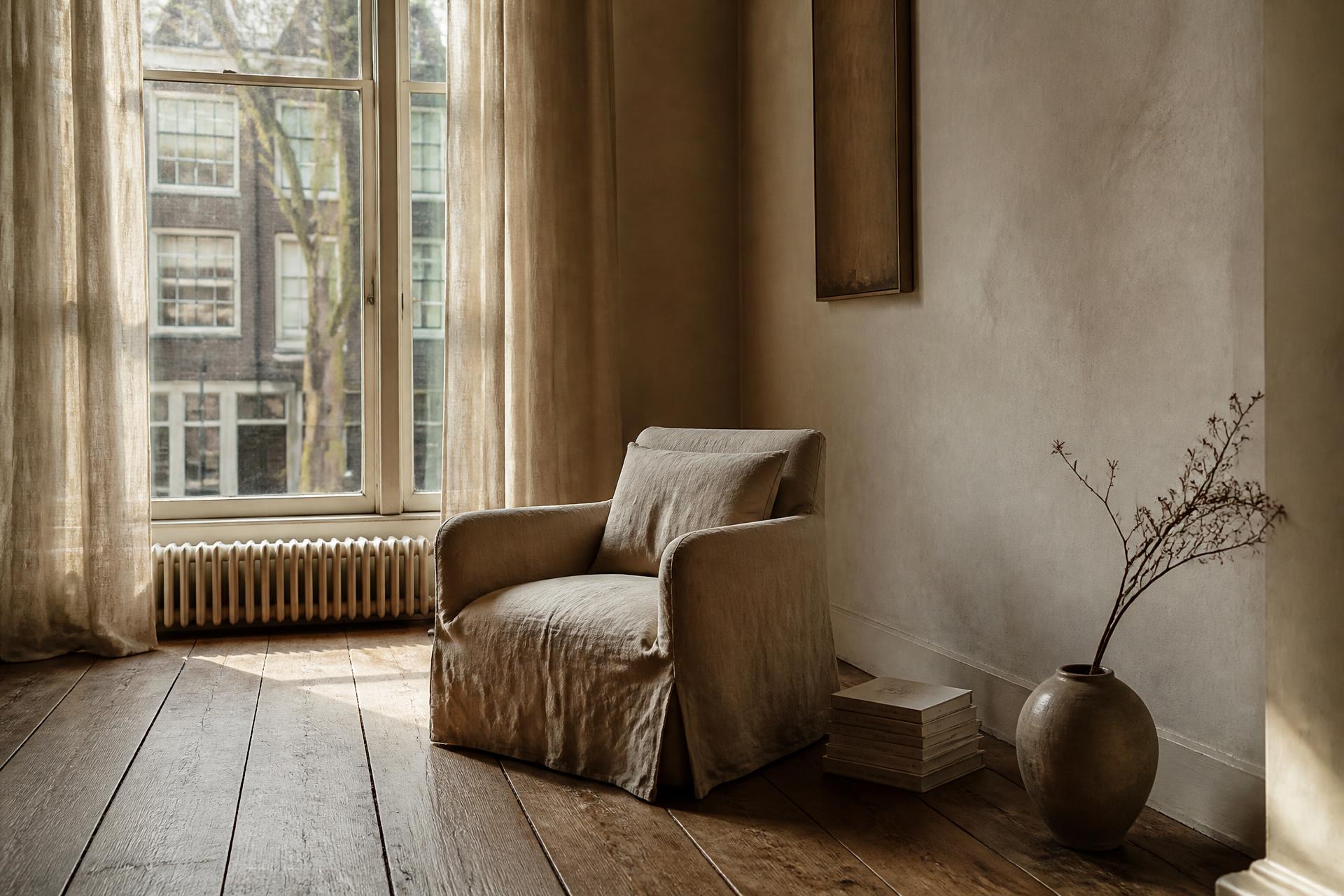
A useful test: identify the room's true focal point. Not the television. The window, the fireplace, the piece of art with the most weight. Now check whether the largest piece of furniture is oriented toward it. If not, that single rotation is often the entire fix. Rooms in which the sofa faces a wall and the television is on a side console feel calmer than the reverse, even to people who watch a great deal of television.
Listen to the room
Hard floors, plaster walls, single-glazed windows and a low ceiling produce a specific kind of acoustic fatigue that people rarely name but almost always feel. If a room feels tense in a way you cannot explain, clap once in the middle of it and listen for the echo. If it rings, the room needs soft mass. A rug with weight. Full-length curtains rather than blinds. An upholstered chair rather than a wooden one. Books on open shelves absorb an astonishing amount of sound.
The corrections here are cumulative rather than dramatic. A single rug alone will not settle a hard room. A rug, a pair of curtains and a bookshelf together will. Every soft surface added reduces the reverberation by a small amount, and the aggregate is what the ear registers as calm.
Trace how you actually move
Sit at the kitchen table and mentally walk yourself through a Tuesday evening. From the front door to the kettle. From the kettle to the fridge. From the fridge to the sofa. Are you passing behind someone who is trying to cook. Are you climbing over a coffee table to reach a lamp switch. Circulation problems create a low, constant irritation that people attribute to the house being too small when in fact it is arranged against their actual routines.
The fix is rarely structural. Move the coffee table twenty centimetres. Rotate the dining table ninety degrees. Put the shoe drawer where the shoes actually come off, not where the previous owner kept theirs. A house arranged for the actual paths its occupants walk feels dramatically larger than one that is not, without changing a wall.
And finally, the memory
Some rooms feel wrong because they hold objects from a life you have finished with. A wedding gift from a marriage that ended. A sofa chosen in a rented flat you were unhappy in. A colour a previous occupant loved. You do not need to discard these things wholesale, but you should notice them, and consider whether they are earning their place in the life you are actually living now.
Memory shows up in colour palettes as often as in objects. A wall painted the previous owner's favourite green, an accent cushion inherited from a difficult phase, curtains chosen for a house you have since moved out of. When a room's palette pre-dates the life currently lived in it, the room reads as slightly borrowed, even to occupants who cannot name why.
The order in which to make the corrections
The five fronts are worth addressing in a particular sequence. Light first, because it is quickest and most transformative. Then proportion, because it is free. Then sound, because it accumulates. Then circulation, because it repays every small adjustment. Memory last, because it takes the longest to sit with and the honesty is harder.
A house that feels right is rarely the result of a great deal of money. More often it is the accumulation of five or six small corrections, made in the right order, to a room that had been quietly working against its occupants for years.