If you have spent any time online recently, you will have seen the term "house burping" doing the rounds. It sounds absurd, but the practice behind it is anything but. It is simply the German habit of Lüften: opening your windows wide for a short, sharp burst of fresh air, every single day, regardless of the season.
In Germany, this is not a trend. It is a deeply ingrained cultural practice, as ordinary as making the bed. Most Germans learn to Lüften as children, and many rental agreements actually include clauses requiring tenants to air their homes regularly. The reasoning is straightforward: stale, moisture-laden indoor air causes problems. Mould, dust mites, poor sleep, lingering cooking smells, that heavy, sluggish feeling when you walk into a room that has not had a window open in days.
For those of us living in older Dutch and European homes, this is especially relevant.
Why It Matters in Older Homes
Period properties, canal houses, pre-war apartments: these buildings were designed for a different era of living. Thick walls, smaller windows, less mechanical ventilation. They hold moisture in a way that modern builds, with their HRV systems and vapour barriers, are engineered to avoid.
If you have ever noticed condensation on your windows in winter, a musty smell in a rarely used room, or paint that seems to blister near a bathroom, you are seeing the effects of insufficient ventilation. Left unchecked, this leads to mould, which is not just unsightly but genuinely harmful to both the building fabric and your health.
Lüften is the simplest intervention. It costs nothing, takes minutes, and makes an immediate difference to how a space feels and smells.
How to Do It Properly
The key distinction is between Stoßlüften (shock ventilation) and simply leaving a window cracked open all day. The latter is common but largely ineffective, particularly in winter, because it cools the room gradually without actually exchanging the air volume.
Stoßlüften: the proper method
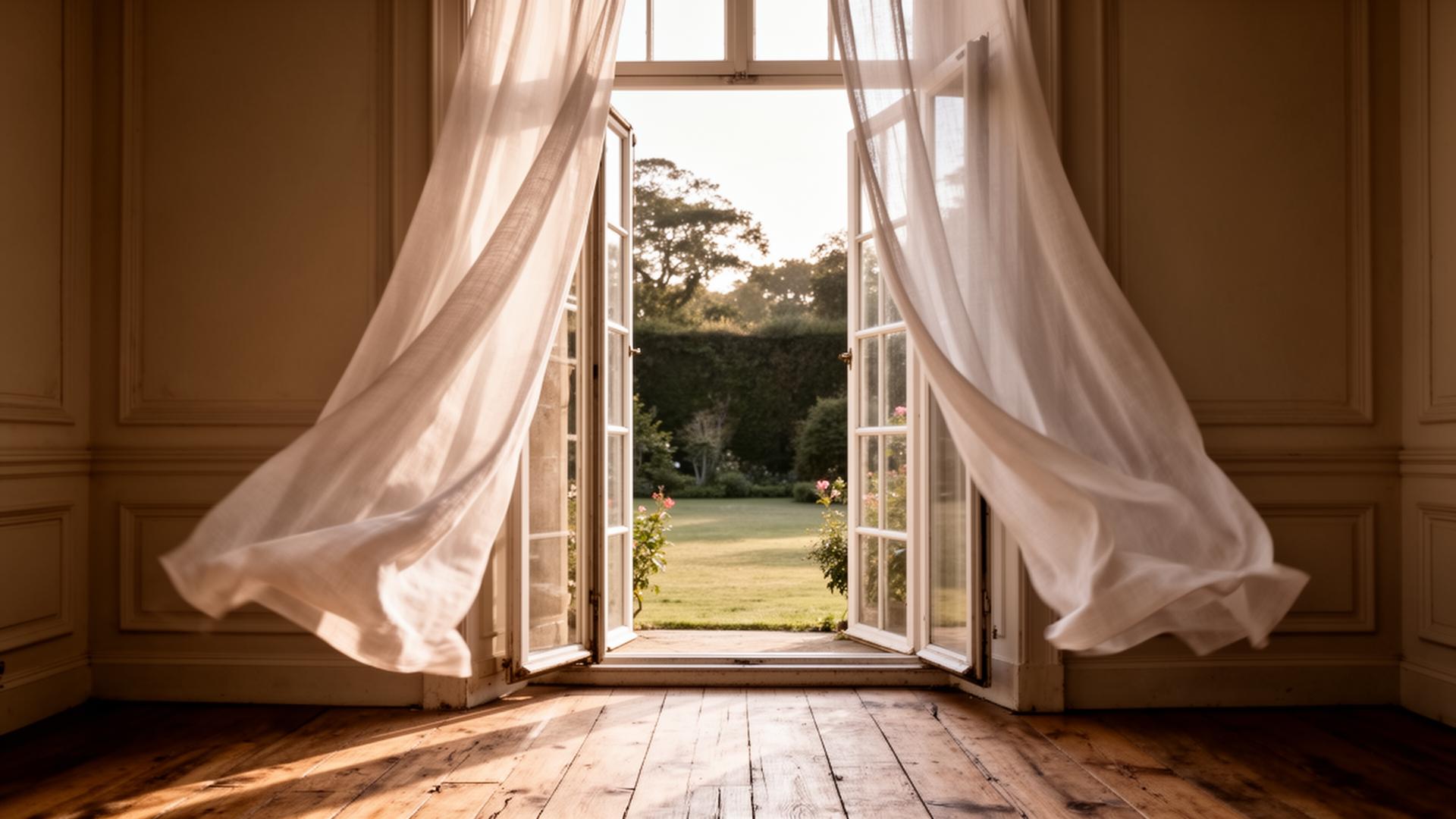
Open your windows fully, as wide as they go, for five to fifteen minutes. If you can create a cross-draught by opening windows on opposite sides of the home, even better. This is called Querlüften, and it exchanges the entire volume of air in a room within minutes.
Then close everything again. The walls, floors, and furniture, which have retained their warmth, quickly bring the room back to temperature. You lose very little heat but gain entirely fresh air.
How often: Ideally two to three times a day. Morning, after cooking, and before bed is a good rhythm.
In winter: Yes, especially in winter. Cold air holds less moisture than warm air, so a brief burst of cold, dry air replaces warm, damp indoor air very effectively. Five minutes is usually sufficient.
In summer: Longer is fine. Ten to fifteen minutes, or more if there is a breeze.
The Dutch Context
The Netherlands has a particular relationship with damp. Low-lying, often humid, with a building stock that includes everything from seventeenth-century canal houses to 1930s social housing. Many of these homes have limited mechanical ventilation, and the climate means moisture is a year-round concern.
If you live in an older Dutch property, regular Lüften is one of the most practical things you can do to protect both your health and your home. It helps prevent the conditions that lead to mould growth, reduces indoor pollutants, and makes rooms feel noticeably fresher.
It also has an effect that is harder to quantify but immediately noticeable: a well-aired home simply feels better to be in. There is a lightness to a room that has had fresh air move through it, a clarity that no candle or diffuser can replicate.
The Scandinavian Approach
If the Germans are disciplined about airing their homes, the Scandinavians take it a step further and air themselves.
Across Norway, Sweden, Denmark, and Finland, sleeping with an open window is standard practice, even in the depths of winter when temperatures drop well below freezing. The logic is the same as Lüften, continuous fresh air exchange, but applied overnight. A thick duvet, woollen socks, and sometimes a hot water bottle handle the warmth. The cold air handles the rest: better sleep, clearer breathing, and a bedroom that never develops that stale, overheated heaviness.
This is not limited to bedtime. In Scandinavia, it is entirely normal to see babies napping outdoors in prams, bundled up and parked on balconies or outside cafes in sub-zero temperatures. The practice is backed by decades of cultural habit and, increasingly, by research suggesting that children who nap in cold fresh air sleep longer and more deeply.
The broader philosophy at work is friluftsliv, a Norwegian and Swedish concept that translates roughly as "open-air living." It is less a wellness trend and more a foundational cultural value: the belief that daily exposure to fresh air, in all weather, is essential to physical and mental wellbeing. It shapes everything from school design (outdoor classrooms) to workplace culture (walking meetings) to, yes, how people ventilate their homes.
What strikes me about the Scandinavian approach is how unsentimental it is. There is no gadget, no app, no expensive system. Just open the window. Use a hot water bottle if you are cold. The simplicity is the point.
For those of us in older European homes, there is a useful lesson here: the problem is rarely that our homes are too draughty. It is that we have sealed them up too tightly and then complained about the air quality. The Scandinavians, living in some of the coldest climates on earth, solved this centuries ago by simply refusing to close the window.
Making It Part of Your Routine
The beauty of Lüften is its simplicity. It requires no equipment, no investment, no renovation. Just a few minutes each day with the windows open.
I have made it part of my morning routine: kettle on, windows open, let the air move through while the coffee brews. By the time I close them, the house feels reset. It is one of those small, unglamorous habits that makes a genuine difference to how a home feels day to day.
If your home has been sealed up for weeks, start today. Open everything. Let it breathe. Your walls will thank you.